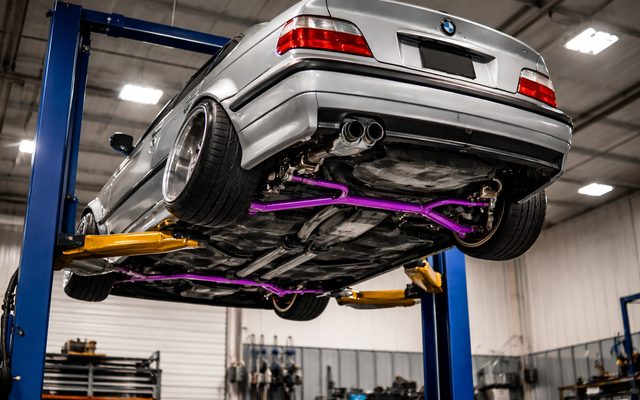
In the high-stakes arena of contemporary professional sliding, success is far more than solely a result of brute horsepower or pilot bravado. Rather, it has become a multifaceted discipline that necessitates a meticulous blend of selecting a proven chassis, equipping it with the most precise performance hardware, and, most essentially, grasping its live characteristics on the circuit through advanced vehicle dynamics analysis tools. This exhaustive handbook will serve as your blueprint starting from the very first concept of a competition vehicle right through to the final telemetry-optimized refinements that transform a strong vehicle into a repeatable podium finisher. We will examine in detail the precise engineering of vehicle alignment optimization, showing how a state-of-the-art drift tuning app like a dedicated telemetry system eradicates guesswork and offers exceptional insight into your car's actual behavior.
The bedrock of any successful drift car is, without question, the base vehicle itself. Certain cars have achieved renowned reputation within the international oversteer scene due to their natural balance, robust construction, and the immense range of performance components available. Choosing the optimal starting point is the first and most significant decision a driver will make. To illustrate, the BMW's E36 3 Series is widely regarded as one of the finest all-around cars for drifting of the modern era. Its excellent evenly distributed mass, combined with a driven rear axle layout and robust six-cylinder engines, establishes a chassis that is simultaneously easy to handle for beginners and incredibly effective in the possession of a expert driver. The successor of this concept, the BMW E46, improves on these attributes with a even more refined chassis, increased wheel track for greater stability, and even a greater degree of lock straight from the factory. A different formidable platform in the professional scene is the Corvette C6.
This muscle-derived track weapon brings a unique array of benefits to the sliding discipline, featuring a light aluminium chassis, a transaxle-style gearbox and differential unit that helps create an perfect weight distribution, and the colossal thrust of a powerful LS V8 motor. This combination renders it an complete monster on track, capable of initiating and maintaining long drifts with seemingly minimal application of acceleration. For builders looking for remarkable performance per dollar, the 350Z model Nissan stands out as a top-tier candidate. It comes from the manufacturer with a stiff chassis, a effective original locking differential, and the responsive VQ series motor that provides ample performance for mastering and advancing in the discipline. Its successor, the Nissan 370Z, presents additional advancements in chassis stiffness, suspension design, and overall powerplant performance, cementing its position as a favorite choice among serious competitors. Other iconic platforms that warrant consideration encompass the agile rotary-powered FC generation RX-7, the ever-present S13 Silvia/240SX, the V8-powered SN95 generation Mustang, the electronic-equipped E90 3 Series, and the tiny yet surprisingly fun and forgiving Mazda MX-5. All of these chassis provides a distinct array of attributes, difficulties, and possibilities, but they all have in common the core components required to become a capable drift machine.
However, picking the correct chassis is only the beginning. To release the full potential of every of these cars, major upgrades to the steering geometry and suspension systems are utterly mandatory. This is where the world of specialist drift-spec hardware comes into sharp importance. The one most game-changing modification for a dedicated drift machine is the integration of a drift-spec angle modification kit. These sophisticated assemblies, for example those manufactured by specialist companies like SLR, are designed to dramatically enhance the chassis's available turning lock. A standard road car is highly restricted in how far its steering tires can pivot, a design trade-off for public road driving. In sliding, conversely, maximum opposite lock is constantly required to control and hold a slide. An steering kit replaces the stock uprights, rod ends, and sometimes suspension arms with parts that permit the steered wheels to reach degrees of turn over 70 or even 80 degrees, as opposed to a normal factory angle of around 40 to 50 degs.
This vastly expanded steering angle offers the pilot with dramatically greater authority during a drift, enabling it to be far simpler to initiate a oversteer moment, sustain it through a extended turn, and change fluidly from one angle to another. The improvement in drivability is absolutely profound. Combined with a appropriately chosen modification is the every bit as critical upgrade to the vehicle's damping system. Store-bought or including expensive road adjustable suspension are just not intended for the unique and harsh requirements of sliding. A purpose-built system of coilovers is crucial. These specific coilovers have custom damping rates and spring strength that are tuned for the violent mass transition that is inherent of drifting. When a pilot starts a drift, the chassis's inertia is thrown rapidly to the outside of the turn. Proper competition coilovers control this shift in a predictable way, enabling the vehicle to find its balance promptly and offering the operator precise response through the controls and cockpit. They additionally enable precise setting of stance, shock absorber firmness, and cross-weight, which are all key parts of fine-tuning the vehicle's dynamics to a specific venue or competition approach. As a system, a top-tier drift angle kit and a expertly chosen system of drift-spec suspension units constitute the absolute hardware base upon which all future optimization is built.
Once the essential components is fitted, the next vital stage in the build is the precise adjustment of the car's alignment. This is the domain of car suspension tuning, a methodology that can seem overwhelmingly complex to the uninitiated but is, in fact, the key to converting a set of fast components into a harmonious and predictable machine. The most discussed element of tuning for drifting is undoubtedly negative camber. Camber is the tilt of the rim relative to the upright plane when viewed from the forward of the chassis. If the top edge of the tire is angled inward, this is known as inward tilt. In drifting, inward-leaning wheels on the front wheels is universally used and is seen as necessary. The purpose is fundamentally related to vehicle dynamics.
When a chassis is cornering at extreme slip angles, the body rolls toward the outer of the corner. This lean forces the outer front wheel to diminish its best contact patch with the tarmac. By adding an inward tilt, the wheel is pre-angled to compensate for this lean. As the car leans into the corner, the tire becomes more upright on the asphalt, optimizing its traction at the drift telemetry software exact time when it is most required for steering authority. Commonly, front camber settings for a dedicated drift car range from approximately -3 degrees to as much as -5 degrees or even beyond, contingent on the details of the car configuration, tire choice, and operator feel. The rear axle tires also employ inward lean, but the values are usually less and subtler than the front. Too much inward lean at the rear can result in the chassis excessively tail-happy and difficult to manage on power input, as it reduces the available grip area of the driving wheels during forward acceleration. Thus, rear axle adjustments are commonly in the range of -1 degree to -3 degrees, finding a delicate compromise between offering sufficient side bite to assist in starting and maintaining the slide while also maintaining usable hook-up for power-down the corner. Camber is merely one element of the larger alignment picture, which also encompasses toe angle, caster angle, and steer correction adjustment.
Toe angle describes the angle of the tires as seen from above. Toe-in means the leading edges of the wheels are closer together than the trailing edges, while toe-out means the reverse. For sliding, a small amount of front axle toe-out is commonly employed to improve the initial handling reaction, making the car feel more agile and eager to initiate a oversteer moment. Rear axle toe setting is usually set to zero or a extremely minute amount of toe-in to promote straight-line stability under acceleration. caster angle is the frontwards or rearward tilt of the suspension pivot when viewed from the lateral of the vehicle. Increased caster improves self-centering and high-velocity solidity, and it also boosts camber effect during cornering, which is very useful. Setting these values is a detailed dance where a modification to one parameter can and often will affect the others. The traditional process for dialing in a car's alignment for sliding has long been a labor-intensive affair of trial and error. A tuner or team would make a modification based on intuition, run the chassis on track, use the pilot's personal feel and impressions, and then make an additional change. This process would repeat time after time until the chassis felt "good" or the suspension engineering allotted track session ran out. This system is not only incredibly wasteful in terms of time and costs, but it is also inherently imprecise.
Pilot perception is a famously inconsistent data source, influenced by numerous variables such as fatigue, changing track surfaces, weather, and simply the mindset of the operator on that given run. What feels "tail-happy" on one lap might feel "understeery" on the next lap, leading to confusing feedback and frustrating adjustments. This traditional limitation in vehicle dynamics optimization is specifically where modern telemetry systems has stepped in to completely change the landscape.
The development and integration of advanced vehicle dynamics tools has introduced a radically different paradigm for engineering and refining high-performance drift machines. These platforms, represented by innovative systems like modern telemetry hardware, function by directly recording the actual mechanical behavior of the car as it is piloted on the circuit. As opposed to drift angle kits depending on personal feedback, these tools acquire objective information on essential variables such as shock absorber movement, individual tire rotation, acceleration forces, wheel angle, and driver input application. This raw data stream is then interpreted by powerful software that can graph and analyze the data in a comprehensible way. For the first time ever, drivers and teams can observe precisely what the car is performing at every millisecond of a drift. This capability transforms the complete suspension tuning process. Imagine the aforementioned task of setting the front camber for a particular car. Rather than making a change from -3 degrees to -3.5 degrees and then driving several runs to try and "perceive" a difference, a suspension tuning tool can provide real-time and definitive information. The application can display graphically how the tire's loading is acting during the key stages of a drift: initiation, holding the angle, and changing direction. It can show if the existing value is enabling the steering tire to maintain ideal grip or if the tire is overloaded on its external edge.
The system can after analysis provide data-driven advice for modification. Perhaps the data reveals that the outside front tire is still overworking its edge at -3.5 degrees of camber, implying that an increase to negative camber, say -4 degrees, might be warranted. On the other hand, the information might indicate that the tire is failing to coming up to heat or that the inner edge is degrading excessively, which could point to that there is too much negative camber and a modest reduction back to -3.2 degrees would be better efficient. This standard of accuracy and actionable analysis was simply unattainable in the time of exclusively mechanical adjustment.
The benefit of employing a dedicated drift telemetry system goes well beyond merely optimizing camber angles. It becomes an priceless coilover setup tips that is customized to your particular car. When adjusting the shock absorber clickers on your coilovers, instead of relying on general advice or copying another team's settings, you can use the data to analyze how the chassis is reacting in reaction to your changes. The software can show the damper movement data over a section of track, revealing if the shocks are handling the weight transfer effectively or if they are allowing the vehicle to become unsettled uncontrollably after a flick. It can assist in pinpointing challenges like excessive compression or losing droop, permitting you to introduce educated decisions to preload settings, rebound/compression settings, or stance. This approach extends equally to the complex task of car alignment tuning. Beyond camber, the tool can give data into how modifications to toe settings and caster angle are impacting the car's balance during various phases of a slide. For example, it can allow you to find the best amount of front axle toe out for your particular steering rack geometry and piloting technique by showing the speed of initial response and the stability of the car at maximum steering angle. This makes the software an incredibly effective drift suspension tuning guide that is dynamically informed by the actual dynamics of your personal car on the track. It shifts the whole endeavor from a dark art into a scientific development procedure.
Furthermore, the value of a tool like modern telemetry is in no way limited to expert engineers with extensive budgets. For the amateur competitor, it acts as an amazing educational tool. It effectively provides the builder with the analysis of a expert suspension specialist without needing the corresponding overhead. It accelerates the development time by giving unambiguous directions to challenges that would normally take countless track days of experience to understand. A tuner can see how their individual vehicle behaves to different inputs, building a more intuitive knowledge of vehicle dynamics in the process. It furthermore opens up advanced performance tuning techniques, enabling anyone with the ambition to perfect their car to do so in a efficient and productive fashion. This is particularly valuable in a sport like oversteer competition, where setup expertise has historically been a highly secretive asset among professional drivers. Now, that capability can be in the hands of any serious enthusiast.
In summary, the journey to engineering and optimizing the perfect high-performance drift car is a multi-faceted mission that seamlessly integrates classic mechanical principles with revolutionary telemetry solutions. It starts with the informed pick of a legendary car, followed by the installation of critical performance hardware like maximum-angle drift angle kits and correctly specified drift-spec coilovers. The process then advances into the precision phase of chassis dynamics adjustment, where settings like camber, toe setting, and caster angle are precisely adjusted to complement the chassis's modified capabilities and the pilot's individual style. The final step, and what truly separates the today's approach from the traditional methods, is the adoption of a sophisticated suspension tuning application. This system eliminates the uncertainty and trial and error of solely seat-of-the-pants tuning by giving quantifiable, actual data on how the vehicle is truly behaving. It acts as an incredible engineering partner, a comprehensive alignment optimization handbook, and a master performance analyzer. In unison, this complete philosophy ensures that each and every element of the competition vehicle—from the selection of the chassis to the last adjustment on the coilover—is optimized for maximum performance on the competition venue. It represents the full progression of the art of drifting, bridging raw driving skill with precise chassis dynamics to build the ultimate competitive machines possible.